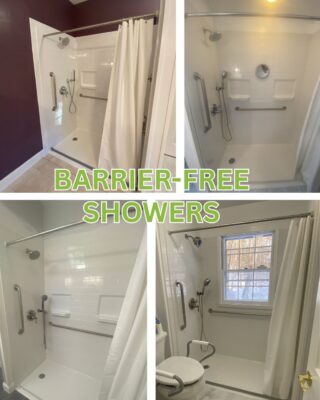
Barrier-free showers are a key feature in accessible and aging-in-place home design. Designed to roll or walk straight in, there is no step, lip or obstacle, making them adaptable for those with mobility issues. Here is a comprehensive guide to barrier-free showers, and what would make them a great option for your home.
What makes a shower barrier-free?
There are a couple of criteria that make a shower barrier-free by definition. Here are some of the things to look for:
- No curb/threshold: the floor is flush with the bathroom floor
- Wide entry: Easily accommodates walkers or wheelchairs
- Open or minimal enclosure: No door, or wide glass panel
- Slip-resistant flooring: textured tile or specialized materials
- Drainage slope: Subtle floor pitch keeps water contained
Benefits of Barrier Free Showers
- Accessibility. You can’t beat the accessibility of these showers. With limited obstacles, they are a breath of fresh air for patients and caretakers, increasing independence and limiting risk of falls.
- Safety: For those with mobility issues, an everyday task like getting into the shower can pose real safety risks. With a barrier-free shower, safety is not a worry, and using the shower can be a more relaxing experience.
- Modern look: Aesthetics are important, and luckily, a barrier-free shower can make your bathroom feel more luxurious than it was before. With a spa-like appearance and modern look, you can transform your regular bathroom into an oasis-like space, making it enjoyable for not only the patient, but all who use it.
- Future-proofing: With these showers, you no longer have to worry about aging and lessening mobility. Knowing that you can age in place can provide real peace of mind for all involved.
- Easier cleaning: With fewer edges and seams, cleaning barrier-free showers is easier than cleaning traditional showers and baths.
Barrier Free vs. Traditional Walk-In Showers: What’s the Difference?
When it comes to choosing the right type of walk-in shower for you, there are a few things to consider. There are two main types of walk-in showers which we will be discussing. The first shower is a barrier-free shower and the second is a traditional walk-in shower. They sound pretty similar, so what’s the difference? A traditional walk-in is designed with a small 2-6 inch step, or curb threshold which the user will step over to get inside the shower. A barrier free shower on the other hand, is curbless. It has zero threshold and is exactly floor height, allowing much more room, easier access, and cleanability. The barrier-free shower is a great option for users who rely on a wheelchair, walker, or any piece of medical equipment that aids their movement and stability.
Traditional walk-ins are more common as they cost less to purchase and have installed. Barrier-free showers are more costly, but prove to be a better solution for anyone with disabilities, or trouble navigating their home. These stylish showers add a sense of luxury to your bathroom and are also perfect for people looking to upgrade the appearance of their bathroom. Whether you are looking to add safety, luxury, or both to your home, a barrier-free shower is sure to satisfy your shower needs!
Things to consider when deciding to get a barrier-free shower:
Installation complexity: Installing these is more difficult than making an upgrade to your regular shower or tub. The process can be time consuming and complex, but the result will be worth the extra planning.
There are multiple stages of planning, including:
- Measuring: Our installers can measure the bathroom and determine the shower size/layout.
- Decide on a drain type: A center drain vs a linear/trench drain. Different bathrooms will have different needs.
- Confirm slope requirements: Barrier-free showers function because they are on a slope, which is typically about ¼ inch per foot towards the drain. Our team will ensure these logistical steps are as easy as possible for you.
- Plan for accessibility features, if necessary, such as benches, grab bars and handheld showers.
It’s also important that during installation, waterproof membrane systems are installed, such as sheet membranes or liquid-applied coatings. This seals all seams, corners and penetrations, and the waterproofing goes beyond the shower area to prevent leaks.
Bathroom layout is also something to take into consideration when installing a barrier-free shower. These types of showers work best with enough space for drainage and spray control.
Why choose On The Mend Medical?
Here at On The Mend, we are dedicated to our customers and our job is to make sure you are happy and comfortable in your home. Our premium customer service and top of the line products are sure to give you the peace of mind you deserve! Don’t believe us? Call any one of our stores to speak with our amazing team members who will do everything in their power to make sure YOU, the customer, is satisfied.
Have questions? Call On the Mend today for a consultation about installing a barrier-free shower.