
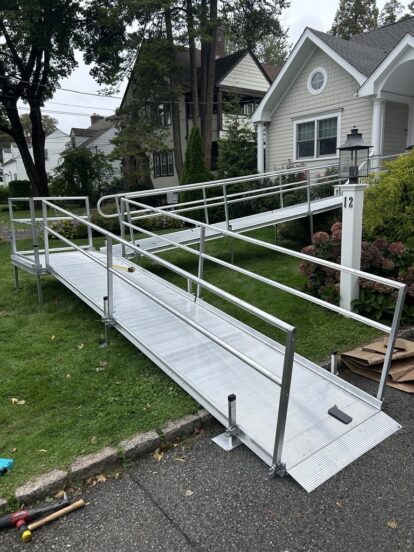
Ramps are an easy way to improve accessibility at your home or business. They help people who use walkers, wheelchairs, or scooters move safely and comfortably. They also support older adults or anyone recovering from surgery, using crutches, or dealing with temporary mobility challenges.
There are several types of ramps, and each serves a different purpose. Below is a breakdown of the most common options, along with their benefits and things to consider.
Kinds of ramps
1. Threshold Ramps
Threshold ramps help with small elevation changes, such as doorways, raised landings, or short curbs. They are usually made of aluminum or metal and are lightweight and portable. Because you can move them easily, they work well for temporary mobility needs, like after surgery or during recovery. They’re also great for visitors who use mobility aids.
These ramps bridge small steps or transitions rather than full staircases. They’re the smallest and most affordable option.
When choosing a threshold ramp, look at three things: slope, width, and a non-slip surface.
A proper incline keeps the user safe. Width matters so a mobility device fits securely. A non-slip surface adds stability, especially in wet weather.
2. Portable Ramps
Portable ramps offer the most flexibility. You can move, fold, and store them with ease. They’re perfect if you need accessibility for only a short time or don’t want permanent changes in your home.
Some models telescope, allowing you to extend or shorten them based on the height you need. Because of this feature, slope concerns become less limiting.
Their compact size and portability reduce stress while traveling, giving users confidence when navigating new environments.
3. Modular/ Semi- Permanent Ramps
Semi-permanent ramps create a long-lasting solution without full construction. They’re built with aluminum panels that can be reconfigured as needed. These ramps usually work best for long-term mobility needs, such as at a home entrance or a business entryway.
They often include handrails for added safety, and their weather-resistant materials make them reliable through all seasons. Because they’re customizable, you can design them to fit the layout of your entry space.
How to pick based on your home entry
-
Small rise: For a single low step (less than 6 inches), a threshold ramp works best.
-
Moderate rise: For one or two steps (12–18 inches), choose a portable or semi-permanent ramp.
-
Large rise: For tall staircases, ongoing needs, or the safest long-term setup, a modular or built-in ramp is the ideal choice.
Affordability
Ramps range in price depending on the products, your needs and more. At On the Mend, we specialize in custom ramp installation, making the process smooth and ensuring you’ll find the best option for you. Our ramps range in price from as low as $40 to as high as $500.
Some of our best products are our SUITCASE brand ramps. The SUITCASE Singlefold AS Ramp, SUITCASE Singlefold Ramp, SUITCASE Top Lip Extension and SUITCASE TRIFOLD AS Ramp are ones that we recommend to our customers.
Safety features to consider
When choosing the ramp for you, there are some features to consider to make sure that you’re maximizing safety and not risking potential injury. Here are some things to keep in mind when making your choice:
- Railings: Railings can help with stability and provide a spot to put your hands if you feel off balance.
- Potential gaps: During installation, it’s important to make sure there’s no gaps between the ramp and the doorway or between the different ramp pieces. With On the Mend, we ensure that ramps are installed with no dangerous gaps.
- Bumpers: Having bumpers on the side of the ramp is especially important for wheelchair users, and they can prevent potential accidents, blocking the wheels from rolling off the side.
- Anti-slip floors: With outdoor ramps in particular, having anti-slip flooring reduces risk of injury and makes the device more accessible during all weather conditions, especially in snow or ice.
Ramp alternatives
Sometimes, a ramp isn’t the best option for your home or business. Alternatives include stair lifts, which are typically used on large flights of stairs, and vertical platform lifts (VPLs). VPLs are also called wheelchair lifts, and can be a good alternative to ramps on particularly steep stairs and limit risk of injury. Wheelchair lifts take up less space and many of them can travel up to 14 feet.
Our website has a comprehensive guide to choosing the right stair lift, which tells you everything you need to know about these devices as an alternative to ramps.
Call On the Mend today for your free consultation!
